
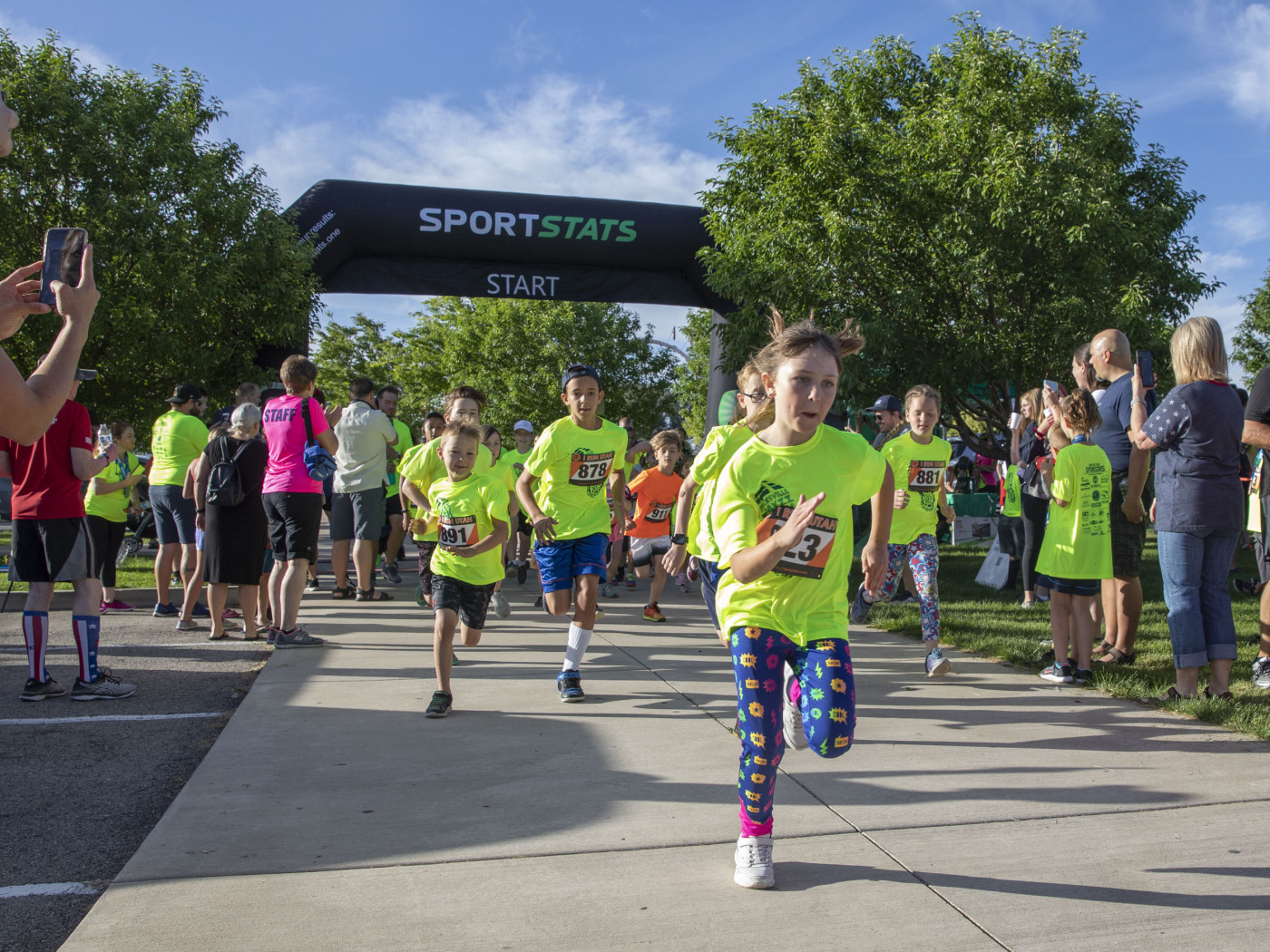
Forty-seven designated communities* have established an accessible community sports program or offered a free or low-cost fitness event as one of their Active Living strategies.
Community Sports Programs or Events for Adults and Children Overview
“45 million children and adolescent participants in the US. Seventy five percent of American families with school-aged children have at least one child participating in organized sports.” - National Library of Medicine. Free or low-cost programs or events include youth sports leagues, community tournaments, access to community centers, 5k runs, fitness challenges, school activity initiatives, and more. Like most Designation strategies, these programs require the commitment and support of the whole community to function properly, from you in the local government to schools, parents, children, businesses, and nonprofit organizations.
Why is it important?
“Getting people active could save the global economy nearly $68 billion annually in medical costs and productivity. The U.S. alone could save up to $28 billion. And individuals could find $2,500 or more in their pocket if they move for 30 minutes five times per week.” - The Lancet Physical Activity Series via Project Play.
Why is it important?
The Aspen Institute’s Project Play gives a list of health benefits of youth sports:
- Regular activity benefits healthy bones, muscles and joints; controls weight and reduces fat; prevents or delays development of high blood pressure
- Sports participation is a significant predictor of young adults’ participation in sports and physical activity throughout their lifetime
- Active communities are healthier
- Active children are less obese in a time that the obesity epidemic continues
- Sports activity helps children develop and improve cognitive skills
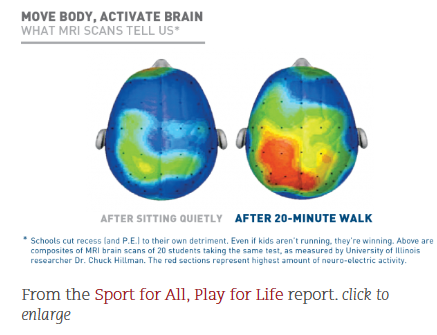
- Physical activity correlates with better mental health in youth
- Sports can positively impact personal development among young people
- Sports provide opportunities for meaningful daily interactions, which reduces loneliness and increases community involvement
How do you do it?
Perhaps more than any other strategy, this one must be tailored to your community’s needs and resources. Therefore, while this section will have pieces of general advice, it also includes numerous examples from Designated communities of all sizes, as small as Annabella (population: 900) and as large as West Valley (population 139,000).
Whether you’re starting a youth sports league, developing a Pickleball tournament, or organization a one-time 5k race, this Brief Guide to Community Event Planning provides the must-dos:
Some of the most popular events or programs outside of youth sports (which is the #1), include:
- Committed individuals or councils focused on health and wellness
- 5k runs, fun runs, annual themed races (biking or running)
- Sports courts: tennis, pickleball, basketball, volleyball, frisbee golf
- School fitness: Outride Program, fitness competitions
- Annual employee passes, sliding scale fees, scholarships for youth sports programs and access to sports/community/recreation centers
- Active community engagement events
Youth Sports
Ankored, whose mission is to simplify the way organizations keep youth sports safe, released Administration 101: The Complete Guide to Running a Youth Sports Organization to help build strong foundations for your youth sports program. To run a smooth and effective program or league, you will need a sports administrator that often works with a board or committee who oversees the program’s activities and makes high-level decisions.
In this handbook, Anchored details 9 key areas sports administrators will take responsibility for.
- Establishing a Legal Entity
You can stay classed as an unincorporated association, which will save effort and costs in the beginning, but cause problems later as you grow. It also leaves individuals liable if things go wrong.
If you choose to form a legal entity, usually the program will be a 501(c)(3) or an LLC. An LLC offers liability protection and flexibility in tax purposes. A 501(c)(3) is a non-profit sports team and will give you tax-exempt status from the IRS. However, to establish a non-profit, you will need to elect corporate offers, apply for a tax ID number, and more. Tax or legal advisors can help you determine which is the best route for you.
- Getting Insurance
“Insurance is an absolutely critical part of running a youth sports organization.” Consider the following types of insurance:
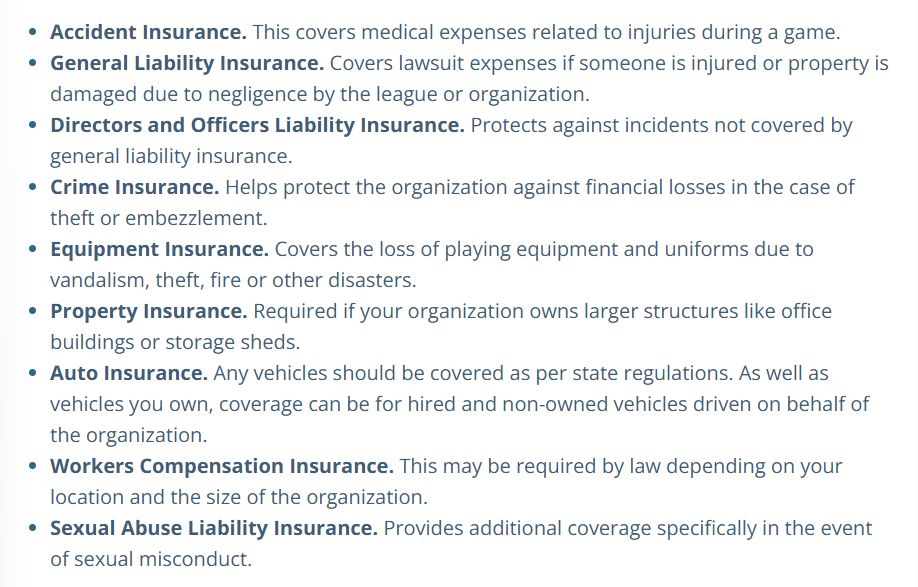
You don’t need all of these; types of insurance will be determined by your specific program’s needs. However, you absolutely should be covered by accident insurance, general liability insurance, and equipment insurance.
- Managing a Budget
Establishing a budget and financial management will help you determine how to structure your program (does your sports admin need a board of directors or a committee or neither?). When developing your estimated revenue and expenses, here are some suggested line items:
-
-
- Equipment
- Staffing
- Training
- Insurance
- Rental expenses
- Marketing & communications
- Miscellaneous expenses
-
If you’re at the beginning of your program, you can track your budget on a spreadsheet. It would be beneficial to invest in a financial management software, however, which will also help you collect payments and manage invoices on top of tracking your budget.
- Establishing a Code of Conduct
Your code of conduct should include expectations of coaches, players, parents, and organization staff (even if it’s just your sports admin). This document should also detail what behaviors are unacceptable and outline the mission of your program. Distribute your Code of Conduct to all players, coaches, parents, and staff at the start of the season. Have each individual sign it to confirm they have read and accepted it.
Ankored gives 4 example Codes of Conduct to get the ball rolling. You don’t have to start from scratch!
- Becoming Compliant
“Compliance means adhering to any applicable laws and regulations dictated by federal, state, and local governing bodies.” Make sure you are aware and following all local, state, and federal laws that apply to your program. Ankored has a Compliance Guide for Youth Sports with a checklist of areas you should cover.
Some compliance subjects to keep in mind:
-
-
- The federal Safe Sport Act
- Return-to-play concussion legislation
- Background check laws
- Abuse prevention training
- Waivers
-
- Registering Players
Registration is a process with many moving parts. You will need to create, distribute, and collect:
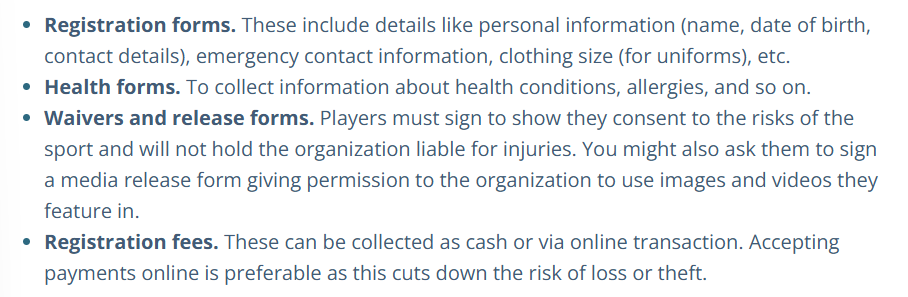
Registration is a great time to ask parents if they want to help out; add a question about volunteering on the registration form to make it easier for them and you.
Registration involves collecting and storing private/personal information, so make sure you’re doing this in a safe and secure way. While HIPAA is not a legal requirement for all youth sports programs, Ankored suggests you use it as a guideline to help you keep a high level of privacy. Their Compliance Guide for Youth Sports (linked above) goes more in depth about HIPAA and tips for how you can follow it.
- Hiring Coaches and Staff
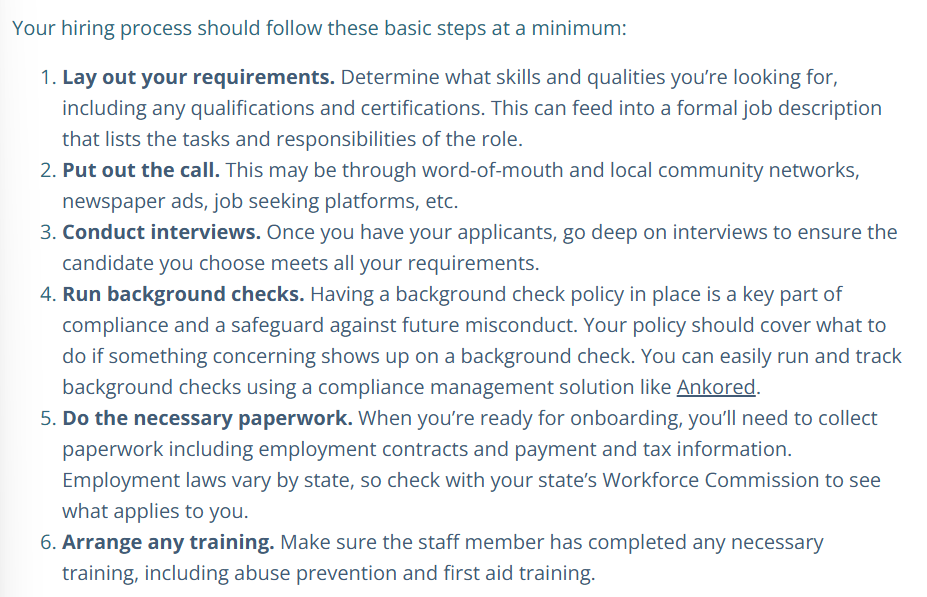
While the legal requirements are different for volunteers than paid staff, you should still have a volunteer agreement in place and run background checks on anyone interacting with minors. All of your staff and volunteers should go through abuse prevention training as well.
- Setting up a Scheduling System
Once you’ve started your program and built the legal foundations, you will start into the day-to-day administration. When you build out your program’s schedule, you need to manage
-
-
- Board meetings
- Coach meetings
- Try-outs
- Training sessions
- Games
- Social events (fundraisers, family engagement)
-
- Marketing Tasks
The main and most important marketing materials of this day and age are website, social media, and mailing lists. Centerville (population 16,500) is active on social media and keeps an up-to-date resource page of their city website that provides information about healthy food access, physical activity opportunities, and connecting with mental health resources. These are great ways to keep the community informed about your services, including youth sports programs, and increase registrations and volunteer sign-ups.
Many large companies are invested in Youth Sports, both in building programs and making them accessible to all children. HERE is a list of 50 Companies who sponsor athletes in Youth Sports.
An example of sponsorships and corporation collaboration comes from Woods Cross (population 11,500). They partnered with the Utah Hockey Club to offer a street hockey league through the local elementary school.
Committed individuals or councils focused on health and wellness
According to Project Play, athletic councils can employ key mechanisms:
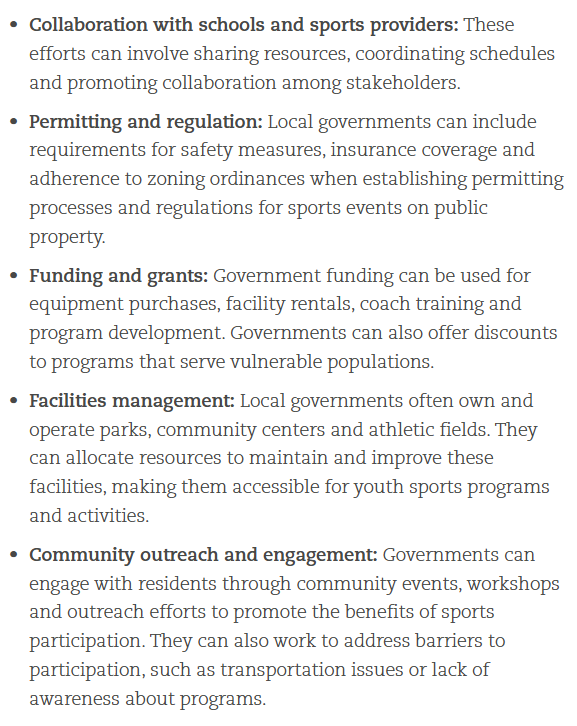
When you are building your council or committee, you want to make sure many types of sectors are represented, including different types of sports, education, and community leaders.
For example, Santaquin (population 15,400) created an ongoing section titled "Healthy Santaquin" on their quarterly Santaquin Community Services Board Committee agenda, setting aside time to discuss activities, points of policy, and events that impact the health of residents. Many cities and towns utilize their recreation departments to manage healthy priorities and programs.
Centerville (population 16,500) established a full-time position within their recreation department specific to health and wellness for the whole community.
St. George (population 84,500) has a LiveWell Coalition which regularly meets to discuss ways to improve the health of residents. The Coalition conducted a needs assessment of the health of the community to determine what residents need and want.
5k Running Events
First and foremost - work with your Parks and Recreation department to determine and obtain the necessary permits (unless another department in your local government oversees special events).
Race Entry has built out a Race Director Guide that details the 4 crucial steps for planning a 5k race.
- Creating an Online Race Registration Form
Your registration form should be fast and simple for participants; do not require account creation if possible and customize the form to each of your races instead of using a general sign-up.
- Planning a Running Location
To select your running location, you need to think through several factors:
-
-
- Proximity to target market
- Scenic attractions
- Safety (will you need to close busy roads?)
- Anticipated number of participants
- Budget (permits, barricades, marketing materials, snacks/water…)
-
- Creating a Race Course
There are 5 million and 1 5ks every year, but you can still make yours special by tailoring it to your community. What scenery or attractions will participants like to see on their runs?
Also consider the elevation. This can determine how well it can be used for walking versus biking races.
When you’re building the shape of your course, the best option is an out-and-back or a loop so that the start and end are in the same place. You can also explore unique shapes (that still start/end in the same place!) so people can watch the shape unfold as they run.
- Organizing a Fun Run
The best way to get your community involved in your 5k is by focusing on the community itself, which makes your run a Fun Run! Here are some example themes from designated Healthy Utah Communities:
-
-
- Manti (population 3,600) hosted a Senior Walk
- Grantsville (population 14,400) offers several annual 5k races: PTA Glow Run, 4th of July Race, and Thanksgiving Turkey Trot.
- Every year, South Jordan (population 80,000) offers the SoJo Race Series, a year-round series of kids runs, 5ks, and 10ks.
-
Once you have your theme (including the race’s name!), work into your budget things like decorations, on-theme food, and any other thematic elements.
After you’ve built out your 5k, you’ll need to promote it. Use your city website, social media channels, newsletters, and community groups to advertise the when, where, and how much. Race entry has a Race Promotion Guide if your registration is struggling or you want to open your races beyond your city or town community. One key point is to open your registration - or at the very least a countdown page - one year in advance. Give people time to prepare and train.
Race Entry has 12 steps for directing your 5k race. We will go through the most important ones here:
Create a budget
Talk to neighboring race organizers about what they spend on certain line items, which should include:
- Permits
- Bib
- Aid station supplies
- Barricades
- Volunteer snacks
- Water bottles
- Start and finish line decor
- Prizes and medals
- Timing
- Shirts and merchandise
- Marketing/outreach
Develop a Sponsorship Program
To use your 5k race as a Designation strategy, it needs to be low-cost or free to the community. Therefore, you probably won’t offset your costs solely on registration fees. Another way to build revenue is by creating sponsorship levels and packages to pitch to local businesses. Sponsorship packages should include marketing benefits (a.k.a. promo for the business). Business contributions can come from monetary sponsorships, but you can also lean on in-kind donations (maybe the local grocery store will donate snacks, or a gift shop can provide prizes), or volunteer hours.
Prepare a Safety Plan
Coordinate with the police if you need security at your event, and make sure you have proper traffic safety devices (cones, barricades). When considering medical and emergency response, you can consult with a sports medicine professional to determine what your event’s specific needs may be.
Time to Race Properly
Consider 4 things when you're looking for a timer:
- Technology
- Experience
- Proximity
- Pricing
This is another question to ask neighboring race organizations: what did they budget for timers and timing technology? Who did they use? What is their process? How much you invest in a timer should be equivalent to the size of your race. If it is small, under 200 participants, you can probably use free options to time the race yourself, but you will need the help of volunteers to coordinate timing. If your race is over 200 people, you really should look into investing into an experienced timer and upgraded technology.
Shirts and Bibs
Shirts are a great souvenir and a way to build community with race participants. Bibs easily identify who is an official participant (as some bystanders or viewers might end up with shirts as well). The bibs should be designed to be quickly read to make timing easier.
Prepare Aid Stations, Hydration & Food
Try to place aid stations every two miles, stocked with water and electrolyte beverages. If you are providing port-a-potties, ensure that you have the proper distance between them and your aid station (check with the health department what the distance is). Other commodities to have at aid stations include pain relievers and food that’s easy to eat on the run (gel packs, granola bars).
At the finish line, you should have high-protein food to support race recovery. This is a great time to ask local markets or restaurants for in-kind donations as a type of sponsorship. Common foods you’ll find at 5k finish lines:
- Doughnuts
- Water
- Coffee
- Tea
- Hot chocolate
- Protein bars
- Trail mix
Recruit and Train Volunteers
Incentives and positive experiences are the best ways to recruit and retain volunteers. Incentives can include a volunteer appreciation gift or party, or free registration/merch. Some pools you can recruit volunteers from:
- Student volunteer organizations
- Local businessesScout troops
- Cheerleading squads
- Youth organizations
Make sure you have a reliable volunteer tracking system that keeps contact information, number of individual volunteers and volunteer hours.
Course Clean Up & Post-Race Review
Have dedicated volunteers for clean-up and set-up to ensure you clean up properly. When the race is finished (and cleaned up!), conduct a review with the following groups:
- Your team
- Volunteer team managers
- Vendors
- Sponsors
- Participants
Ask everyone: what went well, what didn’t, and what changes should be made for next year? Make sure you personalize your thanks to sponsors and build renewal prospects into follow-up conversations.
Your participant survey will be the longest and go to the most people.
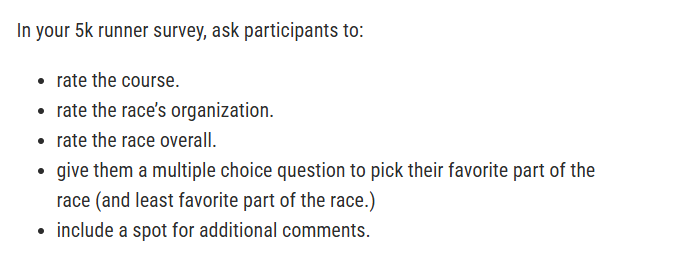
Try to add demographics into your survey (age/age range, gender, annual income range, how long they’ve been running).
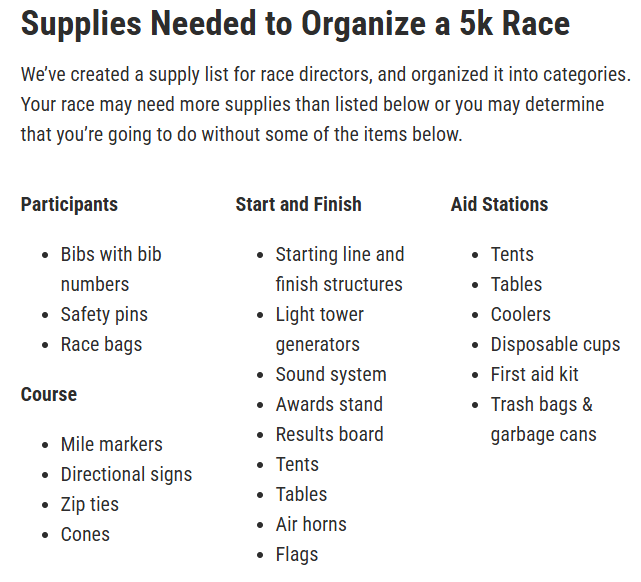
Here is a list by Race Entry of the supplies you’ll need for your race.
Sports Courts: tennis, pickleball, basketball, volleyball, frisbee golf, futsal
A great way to get your community more active is by providing free tools and opportunities for them. Many Designated communities have upgraded sports facilities in parks, community and recreation centers, or even repurposed buildings to focus on physical health. Introducing free tournaments is another incentive for community members to utilize these resources. Here are some examples:
- Annabella ( population 900) installed new equipment to the exercise room in their Community Center, which led to youth participation tripling. They also added a volleyball net to the facility.
- Blanding (population 3,200) added new pickleball courts at the local park and hosted free tournaments.
- Manti (population 3,600) citizens worked together to refurbish tennis courts into tennis courts. The city also hosted fitness activities at their new sports complex.
- Kanab (population 5,100) offers tennis courts, trails, a skate park, and a track.
- Ephraim (population 6,200) installed a frisbee-golf course.
- Grantsville (population 14,400) offers Tai Chi classes at its local senior centers.
- Centerville (population 16,500), through their recreation department, regularly sponsors pickleball tournaments and kickball leagues for youth and adults.
- Payson (population 22,000) maintains a variety of outdoor amenities like pickle ball courts, disc golf courses, and basketball courts.
- Millcreek (population 61,700) installed a futsal court in a portion of the city home to lower-income, immigrant, and refugee populations.
- Provo (population 113,500) is working to build outdoor fitness stations with outdoor exercise equipment (you can find an example HERE, or in the Resources section below)
School Fitness Programs
Kanab (population 5,100) engaged families in physical activity by starting a healthy school competition between elementary students and their parents. Students and parents were provided pedometers to track steps for 20 days. This recorded 27 million steps in its pilot year! This competition was so successful it is now an annual event in Kanab.
South Salt Lake (population 25,500) and Washington (population 32,700) both implemented programs that provide bicycles to residents who don’t have one. Washington also conducts the Outride Bike Program for elementary and middle school students. Outride Bike offers grants that invest in programs that unlock the social, emotional, and cognitive benefits of cycling.
The CDC also has a list of strategies and resources for school and youth physical activity. The strategies include:
- Physical activity clubs
- Recreational sports for fun (intramural programs)
- Interscholastic sports (competitive sports between schools)
- Access to team and individual sports
- Physical activity in before and after school programs
Reducing Barriers
A great way to increase the physical health in your community is to reduce the barriers to sports leagues, activity centers, and other programs. In some Designated communities, like Blanding (population 3,200) and Sandy (population 96,100) businesses increase employee physical health by providing annual passes to the recreation center, or participating in recognition programs that spotlight companies championing good health.
Other Designated programs, like Park City (population 8,300) and South Salt Lake (population 25,500) offer a sliding fee scale for youth and adult programs. Other options are scholarships and vouchers, which is what Designated communities St. George (population 84,500) and Provo (population 113,500) offer.
Community Engagement Events
Finally, community engagement events, whether one-time or annual, are a great way to connect your community while encouraging physical activity. For example, Grantsville (population 14,400) hosts an annual Children’s Pioneer Day Parade and Bicycle Hike to the Splash Pad.
Challenges are also a great way to increase involvement. St George (population 84,500) offered a six-week-long community fitness challenge that saw over 600 registrants and a 73% completion rate. South Jordan (population 80,000) hosts a Winter Fitness Challenge where residents set and meet exercise goals during the cold winter months then report back to receive prizes.
These community engagement events are more important than ever during the obesity and loneliness epidemics facing Utahns. They build social cohesion, which improves mental health, as well as increasing physical activity (and therefore improving physical health). Getting local businesses involved is an added bonus of strengthening your local economy. Ascent Mental Health provided a list of community event benefits:
- Builds lasting social connections
- Boosts your mental well-being
- Helps you discover new skills and passions
- Strengthens local support systems
- Encourages involvement in civic life
- Supports the local economy
- Provides fun ways to stay active
- Creates safer, more connected neighborhoods
- Celebrates diversity and culture
- Drives positive change
Why Focus on Physical Health?
“Without regular activity, your body slowly loses its strength, stamina and ability to function properly. It’s like the old saying: You don’t stop moving from growing old; you grow old from stopping moving. Exercise increases muscle strength, which in turn increases your ability to do other physical activities.” - American Heart Association. In children, physical activity improves memory, attention, and concentration. It reduces disruptive behavior and helps children stay on tasks. In adults, physical activity supports mental wellbeing and reduces the risk of chronic conditions like high blood pressure, heart disease, and strokes.
Utah cities and towns play an important role in shaping active lifestyles through policies, programs, land use decisions, and partnerships.
Resources
*These are designated communities of varying populations that have successfully implemented a community garden. Reach out to them to see if they can share their tips and tricks:
Administration 101: The Complete Guide to Running a Youth Sports Organization
- In-depth how-to for all aspects of starting and maintaining a farmers market, with success stories and added resources included.
- Key mechanisms athletic councils can employ with examples of councils from Fairfax, Virginia and Kansas City, Kansas.
50 Companies Looking to Sponsor Youth Sport Athletes | TeamLinkt
- List of potential corporate funding sources for youth sports programs.
How to Organize a 5K Race: Successful Planning Guide
- Details 4 steps for developing a 5k fun run, tips on how to promote your runs, and how to manage and direct them once they arrive.
A Brief Guide to Community Event Planning
- A 6-point, 2-pager guide on community event planning.
Youth Sports Facts: Benefits - Project Play
- Delves deep into the science behind the health, educational, mental, social, emotional, and financial benefits of youth sports.
Youth sport: positive and negative impact on young athletes - PMC
- In addition to the well-known benefits, this paper discusses the negative impacts of youth sports, including increasing sports-related injuries, overemphasized winning, and challenges based in ethnic cultures, genders, communities, and socioeconomic levels.
Greenfields Outdoor Fitness - Outdoor exercise equipment
- Example of outdoor fitness equipment you can install in your public parks.
- Outride provides research, cycling programs, and funding to empower all people to experience the social, emotional, and cognitive benefits of cycling.
Strategies for School and Youth Programs | Physical Activity | CDC
- Brief overview of types of physical activity programs for youth, plus a robust list of resources.
The Powerful Benefits of Engaging in Community Events — Ascent Mental Health
- Details how community engagement events benefit the individual and the community.
Encouraging Active Living Through Community Events
- Overview of why active community events are important in rural towns with examples of how to do it.
Why Is Physical Activity So Important for Health and Well-Being? | American Heart Association
- Lists the major reasons that physical activity is important in multiple areas.
Is your city or town on the path to being a Healthy Utah Community?
Reach out to our program coordinator, Emma, to learn more about the designation and get guidance on the application process: