
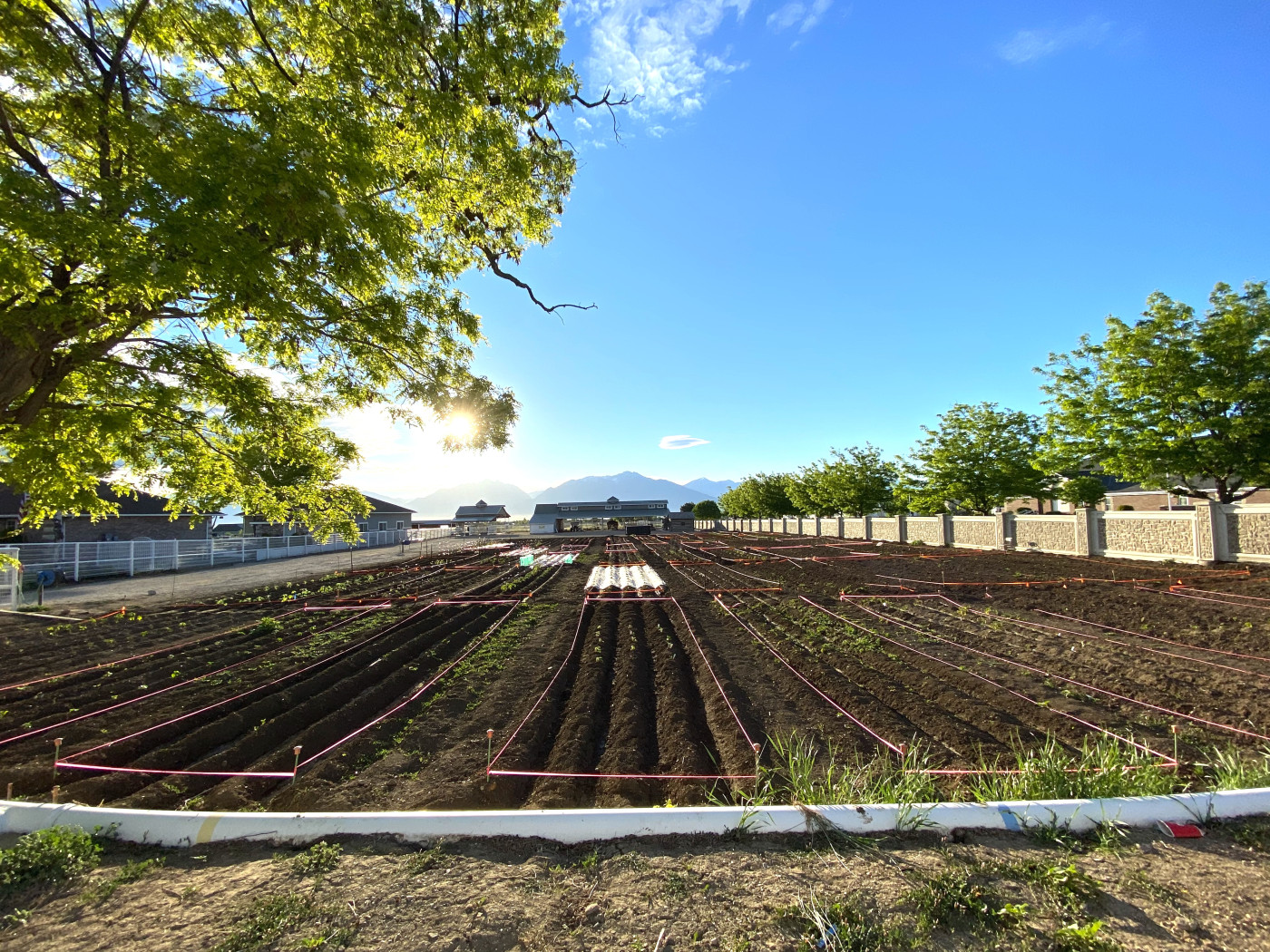
To get designated as a Healthy Utah Community, communities have to complete 1-3 healthy food access strategies depending on their population. One of the most favored healthy food strategies pursued by cities and towns is the community garden Thirty-three designated communities have established a community garden.* It is a cost-effective, community-beautifying initiative that improves access to healthy food.
What is a Community Garden?
“At its most basic, a community garden is any outdoor space available in a community for growing vegetables, fruit, and/or flowers.” (Tulane University Celia Scott Weatherhead School of Public Health & Tropical Medicine).
Your community garden can be city-maintained, offer small plots up to community members, or some combination of both. Vegetables, fruits, herbs, and whatever else you decide to grow can go to members who are maintaining plots, or the produce can be donated to local homeless shelters or food pantries, who are often lacking healthy food resources. What best fits your community’s needs should be the shape your community garden takes.
Why is it important?
When you build a community garden in your city or town, your residents will profit from better access to healthy food and community building opportunities.
Access to Healthy Food:
Multiple studies found that community gardens, on average, produce double the amount of vegetables per square foot compared to conventional farming (M. Bonde, C. Bornstein, R. Goins, C. Twiggs, University of Minnesota). A different study conducted in Flint Michigan found that adults participating in a community garden were 3.5 times more likely than nonparticipants to consume the recommended services of fruits and vegetables. Not only do community gardens provide free or low-cost nutritious food to community members, but they do it efficiently. Delivering Community Benefit considers the followings some key takeaways from a community garden: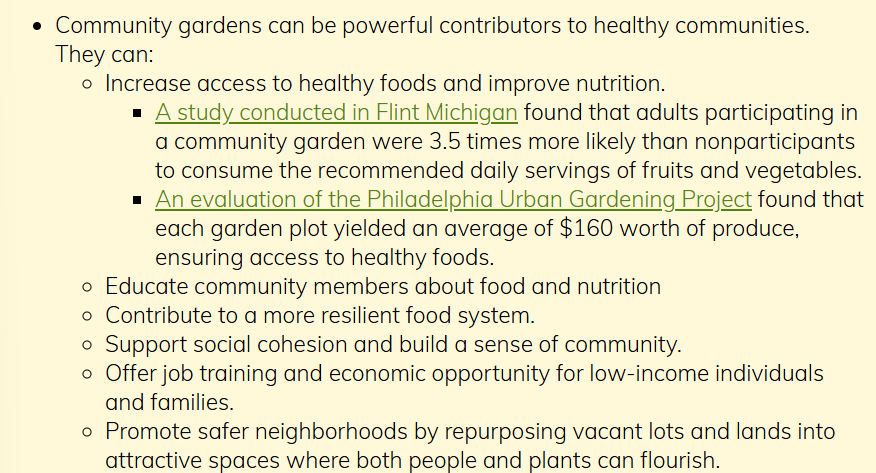
Community Building:
A large community-building aspect of community gardens is beautification; cultivating a community garden in vacant lots can reduce scattered garbage or other hazardous materials that sometimes end up in empty lots. Instead, these spaces become beautiful spaces where community members and nature alike want to spend time. According to the USDA, there is an economic multiplier of 1.66 for every dollar spent on local food, so community gardens can actually boost your local economy if local farms/farmers/farmer’s markets get involved in the project. Community gardens “provides participants with additional income, enables growers to expand and diversify their production, and makes more fresh fruits and vegetables available to the community” (Delivering Community Benefit: Healthy food playbook).
How do You Do It?
As a part of city government, here are some action items to start:
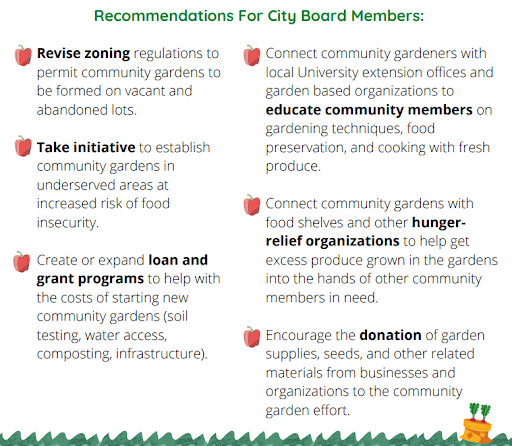
With these ideas in mind, you can develop a community garden following these steps:
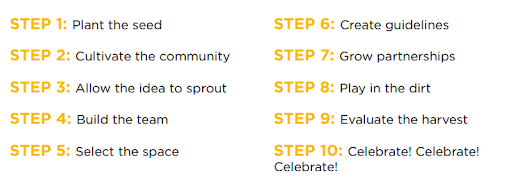
Step 1-4: Get community buy-in and build your community garden leadership team
Tapping into your health coalition is a great way to find support in starting and maintaining a successful community garden. Discuss responsibilities of each coalition member, including plot maintenance, seed acquisition and planting, marketing, and produce distribution. Pull in volunteers from the community for increased community investment and extended capacity.
Step 5: Select the space
There are two main types of a community garden: Allotment and Communal. 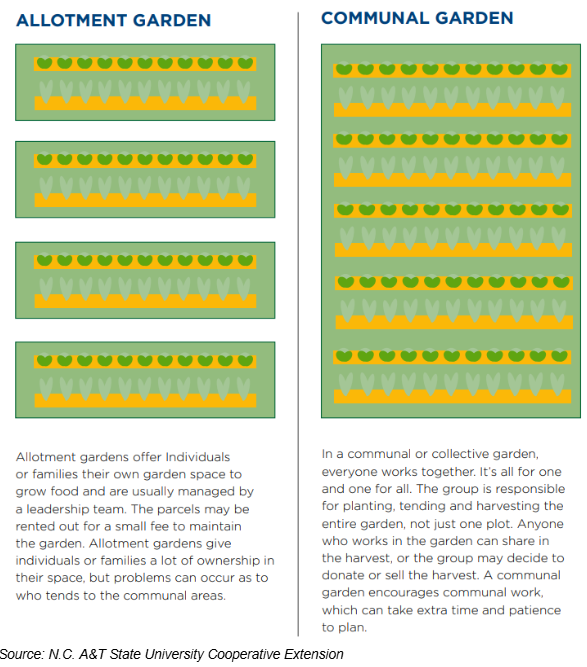
Once you have determined what type of community garden will work best for your community, dedicate a plot for the project. A great piece of land for a community garden has the following attributes:
- Gets six-to-eight hours of sun each day
- Sit relatively flat
- Have only manageable debris (can be removed by volunteers with basic tools)
- Be in a central location
- Have access to water and good drainage!
- A site without paving and soil relatively free of trash and debris is best
- You can also start a raised-bed or container community garden in a paved or concrete space if that’s what is available to your community.
Keep in mind if community members use the plot for any other purpose, such as for play or a path or a gathering place. Incorporate these other uses if you can. You will also need a shed for gardening tools and supplies (approach businesses and appeal to the community to see if you can get items donated!)
Step 6: Create Guidelines
Garden guidelines create clear expectations for garden use. Use your community garden leadership (recommended: healthy coalition) to regularly update and amend as needed. To start:
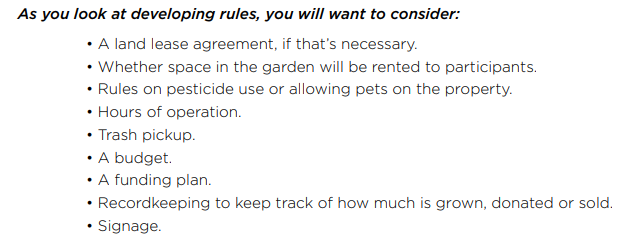
Involve community members in this process where possible! That will give them a sense of ownership and pride in the garden. Also, create a sign-up process for community members, whether that’s for individual plot use or general garden management volunteering (weeding, tool/supply tracking and upkeep, harvesting, etc).
Note on pesticide use: If you want to reduce pests without pesticides, grow bright flowers alongside produce. The bright flowers will attract bigger insects that will keep plant-eating pests away (SeedMoney).
Step 7: Grow Partnerships
Connect with local businesses and organizations to establish sustainability in your community garden. These partners can donate tools, seeds, soil, fertilizer, and even time to increase your garden’s chance for success.
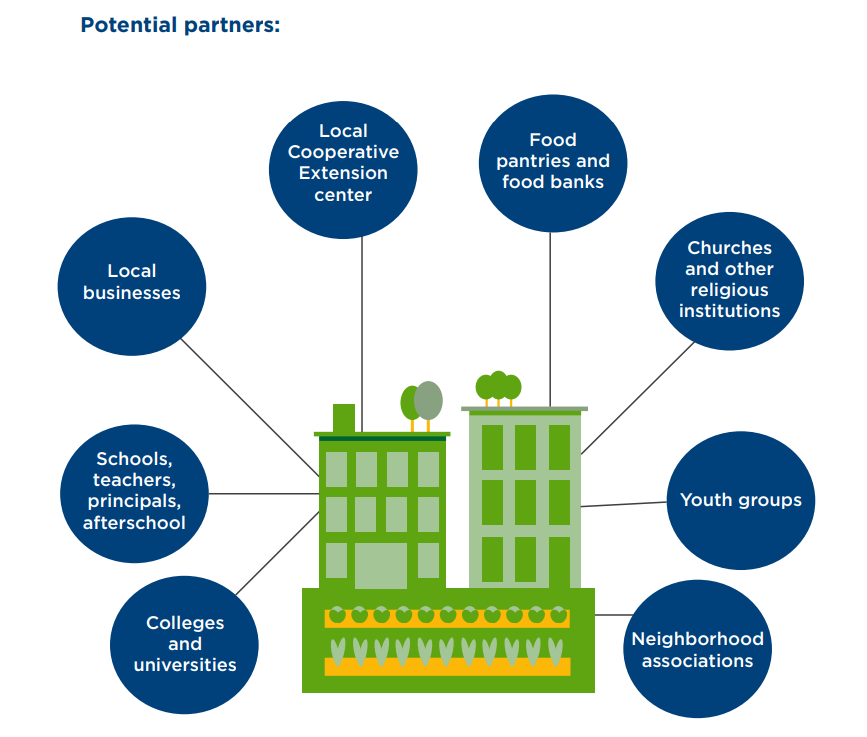
Connecting with University extensions and garden-based organizations is a great way to educate community members on gardening techniques and what to do with the produce once it has been harvested (cleaning and cooking with fresh produce, preserving, etc.). Students looking for volunteer opportunities can also be a great avenue for expanding your capacity.
Step 8: Play in the dirt
A community garden can be more than just a place to garden! Encouraging events in or near the garden really brings in the community connection and mental wellness aspects of the project. Some events and opportunities you can offer through the garden:
- Seed swaps
- Garden tours
- Fresh-food potlucks
- Gardening workshops/classes
- Volunteer appreciation
Step 9: Evaluate the harvest
So, you’ve set the garden up. You’ve got the space ready, the supplies donated, the volunteers ready. But what should you grow? And how often should you ask yourself that question?
Lean on your community to determine what produce will be used the most. Open polls or surveys, or have options for input at a city townhall to see what vegetables, fruits, and herbs community members want and need the most.
Once a year, community garden leaders should evaluate the community garden’s health and progress. According to the N.C. A&T State University Cooperative Extension, some things you might consider when evaluating your garden are:
- What needs did we address by having this garden?
- How did people feel when they came to the garden?
- Did the foods we grow change any eating habits?
- Was there more access to fresh fruits and vegetables?
- If we sold produce, did we make any money?
- What challenges did we encounter?
- What factors may have affected the garden's outcome (weather, location, lack of help)?
- What skills do we need to be more success with our garden?
Step 10: Celebrate!
Fall harvests are a great way to bring everyone together to reap the rewards of all their hard work. Find ways to celebrate and appreciate community garden leaders and volunteers. Collect success and impact stories.
NOTE: As you work through this list, Community FRESH: A guide to growing community gardens has checklists for each step to help you get the most out of your community garden!
Why Focus on Healthy Food Access
Access to affordable, nutritious food is essential to the health and wellbeing of Utahns. Communities with limited access to healthy food experience higher rates of chronic disease, including type 2 diabetes and heart disease, as well as increased healthcare costs and decreased quality of life. Food environments shaped by income, geography, transportation, and affordability barriers disproportionately affect communities with limited access to healthy food, including low-income communities and older adults.
Utah cities and towns play an important role in shaping local food environments through policies, programs, land use decisions, and partnerships. However, many municipalities report limited funding, expertise, and support to address healthy food access effectively.
Resources
*These are designated communities of varying populations that have successfully implemented a community garden. Reach out to them to see if they can share their tips and tricks:
- Local organization whose mission is empowering people to grow and eat healthy, organic, local food.
Improve access through community gardens
- Pamphlet on how community gardens tackle food insecurity and lists action items for City Board Members.
Public health benefits of a community garden
- Resources for beginning a garden (organization, types of seeds, etc), and the public healthy benefits of community gardens, such as access to local, healthy food, community beautification, educational opportunities, and an enhanced sense of community.
- Describes how community gardens contribute to healthy communities, including food access, education, sense of community, and safer neighborhoods. This source also details how hospital communities can get involved with starting and maintaining community gardens.
- Outlines the benefits of community gardens, how to find gardens near you, ways to start and maintain a garden, and provides a list of external resources.
American Community Gardening Association
- Resource hub for all things community gardens.
- ACGA Resources for starting a community garden
Community Garden Start-Up Guide from Fargo City
- This “Community Garden Start-Up Guide” is intended to help interested parties start and sustain a community garden. It also includes worksheets and sample forms and letters, including marketing materials, volunteer agreements, and donation letters.
County Health Rankings & Roadmaps: Community gardens
- Bullet points of expected and potential benefits, research about effectiveness, and implementation examples/resources.
Is your city or town on the path to being a Healthy Utah Community?
Reach out to our program coordinator, Emma, to learn more about the designation and get guidance on the application process: